
Missing Property Line Markers After Landscaping?
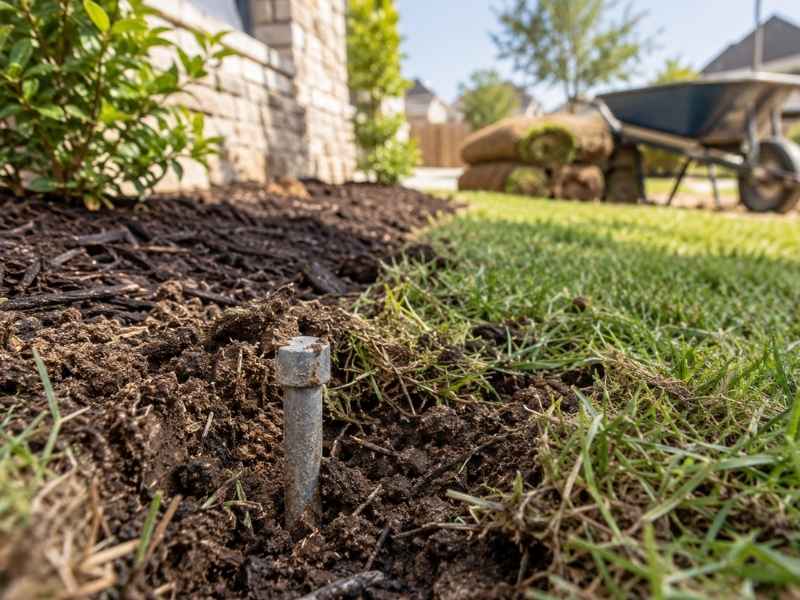
You just finished a big yard project. New sod, fresh mulch, maybe a retaining wall. Then you go looking for the old property line markers, the little pins or stakes near your corners, and they’re gone. Property line markers can get buried, shifted, or covered during landscaping work, and that does not mean your boundary changed. It means the evidence just got harder to find. Here’s what actually happened, and what to do about it.
How Landscaping Work Can Disturb or Conceal Property Line Markers
Landscaping changes the surface of your yard. That’s the whole point of it. But the surface is exactly where property markers live, so any major project can bury or bump them without anyone noticing.
Grading is one of the biggest culprits. When a crew reshapes the slope of your yard, they add or remove soil across a wide area. A marker that used to sit flush with the ground can end up six inches under new fill. Sod installation works the same way. A thick new layer of turf and soil can sit right on top of a small metal pin, hiding it completely.
Tree removal is another common cause. Stump grinding and root removal disturb a large radius of soil, and heavy equipment rolling through that area can knock a marker loose or drag it several feet from its original spot. Retaining wall construction involves excavation right at the edges of a property, often the exact spot where corner markers sit. Trenching for irrigation lines or drainage pipes cuts through soil in straight paths that frequently cross right over buried survey evidence.
None of these activities are done with bad intent. Landscapers are focused on drainage, plant health, and appearance. Boundary markers are just not on their radar.
Missing, Buried, or Moved? Why the Difference Matters
Here is something a lot of homeowners get wrong. They assume that if they can’t see a marker anymore, it must be gone for good. That’s often not true.
A marker can be in one of three very different situations. It might be buried under new soil or sod, sitting exactly where it always was, just out of sight. It might be physically disturbed, meaning equipment nicked it, tilted it, or pushed it slightly without fully removing it. Or it might be completely removed, pulled out during excavation and never put back.
The difference matters because each situation calls for a different response. A buried marker can often be found again with the right tools and a little digging in the right spot. A disturbed marker might still hold clues to its original position, even if it’s no longer perfectly placed. A removed marker leaves no direct physical evidence at all, so the boundary has to be re-established using other methods.
This is also why homeowners should be careful about jumping to conclusions. Finding an unfamiliar stake somewhere in the yard does not automatically mean your property corner moved. It could be an old irrigation marker, a leftover survey lath from a different job, or debris that has nothing to do with your boundary. Don’t treat a random object as proof of anything until it’s been properly checked.
Why Homeowners Should Not Reposition a Suspected Survey Marker Themselves
Let’s say you find an old pin, but it’s sitting a few feet from where you expected your corner to be. The instinct is to move it back to where it “should” be. Resist that instinct completely.
Landscaping equipment displaces physical evidence all the time. Skid steers, mini excavators, and even hand tools can nudge a marker out of place without anyone realizing it happened. Once that marker has moved, its current position no longer tells the true story of where the boundary actually sits. And if a homeowner then moves it again based on a guess, the evidence becomes even less reliable.
Your fence line, the edge of your lawn, or a measurement you took with a tape measure are not substitutes for actual boundary evidence. Fences get built a foot or two off the real line all the time, often because that’s where it was convenient to dig postholes. Lawn edges follow mowing habits, not legal boundaries. None of these everyday features can be trusted to show where a corner truly sits.
The original position of a boundary marker has to be worked out from survey evidence, not estimated by eye. If you’ve found something that might be a disturbed marker, leave it exactly where it is and get it evaluated before touching it again.
How a Surveyor Re-Establishes a Corner After Landscaping Has Altered the Site
When landscaping has wiped out the visible evidence at a corner, a licensed land surveyor doesn’t just guess where it used to be. They work backward using several sources of information at once.
First, they look for any remaining physical evidence near the corner, even small fragments like a bent pin, a chunk of concrete, or a partial pipe. Second, they pull recorded information, including the legal description of the property, subdivision plats, and prior survey records tied to that specific parcel. Third, they check adjoining boundary evidence, meaning markers or fences on neighboring properties that can help confirm where a shared line should fall.
Finally, they take new measurements on-site and compare all of it together. Recorded distances, angles, and reference points get checked against what still exists in the ground. This process lets a surveyor place a new marker with confidence, even when the original one is completely gone.
This is a job for a professional with the right instruments and training, not a homeowner with a shovel and a hunch.
Protecting Property Corner Locations During Future Yard Improvements
If you’re planning another big landscaping project, a little preparation can save you from repeating this whole situation.
Start by identifying where your important corner areas are before work begins. If you already have a survey or recorded pin locations, mark those spots clearly, even with a simple flag or stake, so crews know to steer clear. Tell your landscaping contractor directly that survey evidence may be present in those areas. Most crews will happily work around a known spot if you flag it in advance.
Avoid heavy excavation, grading, or trenching immediately around known monument locations whenever possible. If your project absolutely requires digging near a corner, consider requesting professional marking beforehand, so a surveyor can document the exact location before any equipment touches that ground.
A few minutes of planning before a project starts is far easier than tracking down lost boundary evidence after the fact.
Frequently Asked Questions
Can landscaping completely bury a property line marker?
Yes. Grading, sod installation, and soil buildup can cover a marker entirely, even though it’s still sitting in its original spot underground.
What should I do if a survey marker disappeared after grading my yard?
Avoid digging around randomly. Contact a licensed surveyor who can check remaining evidence and re-establish the corner using proper methods.
Can a landscaper accidentally move a property corner marker?
Yes. Equipment used for grading, trenching, or stump removal can shift a marker without the crew realizing it happened.
Should I dig for a property line marker if I know approximately where it was?
No. Digging on your own risks damaging remaining evidence further. Let a professional locate and confirm it properly.
Can I put a survey pin back where I think it originally was?
No. Repositioning a marker based on a guess destroys its value as evidence. The original location must be confirmed through survey methods, not estimation.
